

Blog
Last updated:
October 8, 2026
26
min read

The best intranet platforms in 2026 includes Oak Engage, Unily, LumApps, Staffbase, Workvivo, Interact, Powell, Simpplr, Happeo and Jostle.
Oak Engage is the best overall choice for organisations that need one intranet platform for frontline, desk-based and remote employees. Other platforms are better suited to specific requirements such as complex enterprise governance, social engagement, multinational communication, Microsoft 365, Google Workspace or AI-powered usability.
This guide compares 10 leading intranet platforms by use case, strengths, limitations and workforce fit to help you choose the right intranet software for your organisation.
How we compared the best intranet software platforms
To compare the best intranet software platforms, we looked at the factors that matter most when organisations choose and roll out a modern intranet:
- Internal communication capability
- Mobile access for employees away from a desk
- Knowledge sharing and document management
- Search and information discovery
- Employee engagement features
- Personalisation and targeting
- Governance and content management
- Microsoft 365, SharePoint, Teams, Google Workspace and HR system integrations
- Analytics and reporting
- Ease of adoption and ongoing administration
No intranet platform is the best fit for every organisation. The right choice depends on your workforce, communication needs, existing technology stack, governance requirements and how much internal resource you have to manage the platform.
Best intranet software platforms compared
Oak Engage is the best overall intranet software for organisations with desk-based, remote and frontline employees because it combines communication, knowledge sharing, employee engagement, mobile access, AI personalisation, targeting, analytics and Microsoft 365 integration in one connected platform.
Unily or Interact may suit highly governed enterprises, Workvivo is strong for culture and social connection, Happeo fits Google Workspace-led organisations, SharePoint or Powell may suit Microsoft document management needs, and Jostle is a simpler option for smaller organisations.
What makes the best intranet in 2026?
The best intranet software brings communication, knowledge, mobile access, search, integrations and engagement into one connected employee experience.
The strongest platforms do not just publish company news. They help employees find trusted information, understand what matters, access workplace tools and stay connected to the wider organisation.
Modern intranet software should support:
- Targeted company news and leadership updates
- A central place for documents, policies and knowledge
- Search that helps employees find answers quickly
- Mobile access for employees away from a desk
- Personalised content based on role, team, location or audience
- Integrations with Microsoft 365, SharePoint, Teams, Google Workspace and HR systems
- Employee engagement features such as comments, surveys and recognition
- Analytics that show reach, adoption and content performance
- Governance tools that keep content accurate and up to date
- Simple administration, so internal teams can manage the platform without heavy technical support
The best intranet is not always the platform with the longest feature list. It is the one employees can actually use, internal teams can actually manage and the organisation can keep improving over time.
The 10 best intranet software in 2026
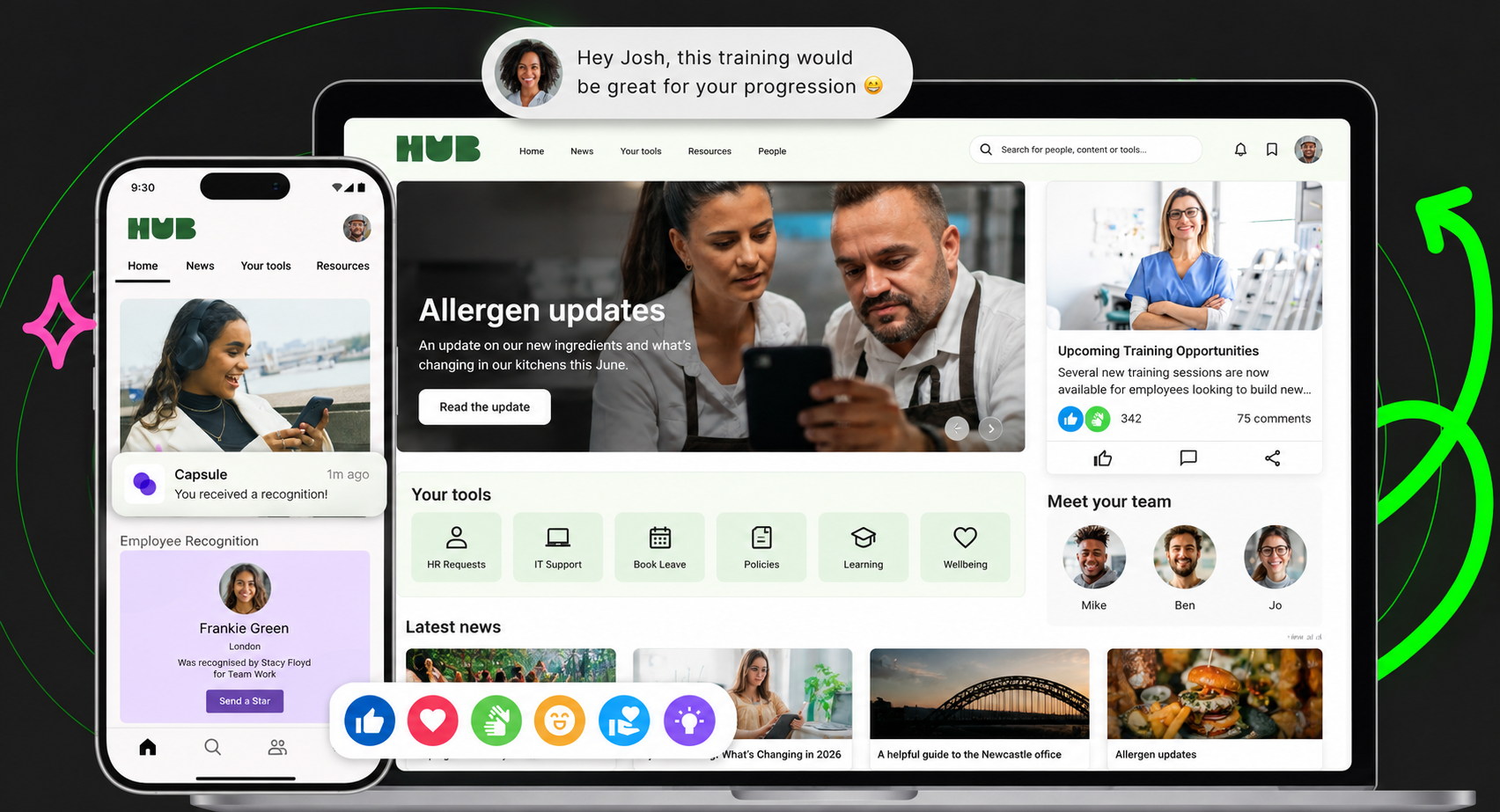
1. Oak Engage: best intranet software for mixed frontline and desk based workforces
Oak Engage combines a company intranet with a mobile employee app, helping organisations provide news, workplace knowledge, communication and employee resources across different locations and devices. It is particularly relevant for businesses with a mixture of frontline and office-based employees.
A restaurant employee may need access to operational guidance, a new starter might need onboarding documents, and a head office employee may be looking for information stored in Microsoft 365. Oak supports these different requirements within the same platform.
Its features include targeted communications, employee recognition, surveys, knowledge sharing, workplace integrations and analytics. Smart Delivery and Aria provide AI-supported personalisation and information discovery.
Why Oak Engage ranks first
Our recommendation is informed by the adoption results and implementation experience documented across Oak's customer base.
These examples cover businesses with very different workforce structures, including large frontline operations and US-based organisations.
Five Guys
Five Guys uses its Oak-powered employee app, Chatty Patty, across restaurants in the UK and Europe.
Previously, communication relied heavily on restaurant managers passing information to their teams. This was particularly difficult because most employees lacked corporate email access.
Chatty Patty reached 97% adoption following its accelerated launch in 48 hours.
According to the Five Guys case study, employee turnover subsequently fell by 56%, from 110% to 48.8%. Five Guys also reported that the improvements contributed to more than £4.3 million in recruitment and onboarding savings.
The example shows how an intranet can become part of everyday restaurant operations, particularly when employees need direct access to guidance, announcements and opportunities to participate.
Sevita
US healthcare organisation Sevita employs approximately 42,000 people.
Before introducing Oak, its previous intranet was only accessible to the 20% of employees with company-issued email addresses.
Sevita Source, powered by Oak Engage, gives employees access to company information, HR support, onboarding materials, policies and other resources.
The platform has achieved 84% adoption.
For organisations with distributed healthcare teams, the main consideration is giving employees consistent access to information while accounting for different locations, roles and operational requirements.
Burger King UK
Burger King UK's BK Hub connects restaurant employees with head office through a branded intranet and mobile app.
With 98% of its workforce working on the frontline, mobile accessibility was central to the implementation.
Burger King reported that 98% of employees had been onboarded and the platform achieved 97% monthly engagement.
In its interview with Oak, the internal communications team also explained how audience targeting helps restaurant employees receive information relevant to their roles and locations.
The business uses dedicated onboarding areas, employee recognition and social spaces alongside operational communication.
Pluralsight
US-based technology company Pluralsight replaced its previous intranet with Life@PS, built on Oak Engage.
The organisation completed its migration in ten days.
Since launch, the platform has recorded 96% user onboarding, 70% monthly engagement and 97% quarterly engagement. Employees also carried out 10,000 searches during its launch quarter.
Pluralsight's experience is particularly relevant to businesses replacing an intranet where poor navigation and difficulty finding information have become everyday frustrations.
Independent recognition
Oak was included among the highest-scoring intranet products in ClearBox Consulting's 2026 Choice Awards.
The assessment also recognised Oak in its Best for Value, AI Innovator and Community Builder categories.
Oak-powered intranets have received recognition through the Institute of Internal Communication, Communicate Magazine and the International Brilliance Awards.
These provide additional context, although the awards use their own evaluation criteria and should not be confused with this article's rankings.
Where Oak Engage is strongest
Oak is worth shortlisting when an organisation has employees working across different locations, devices and shift patterns.
Its main advantages include:
- A shared intranet experience for desk-based and frontline employees.
- Mobile access without requiring every employee to have a corporate email address.
- Targeted news, push notifications and mandatory-read functionality.
- Access to policies, documents and workplace knowledge.
- Microsoft 365, SharePoint, HRIS and other workplace integrations.
- Employee recognition, surveys and community spaces.
- Analytics covering communication reach, engagement and adoption.
- Customer examples across retail, hospitality, healthcare and technology.
Oak is relevant to organisations in retail, hospitality, healthcare and manufacturing, as well as financial services and other sectors with distributed workforces.
Where Oak may be less suitable
Businesses planning a heavily customised intranet with extensive bespoke development should confirm their requirements during procurement.
Oak is primarily designed for employee communication, information access and workplace experience. Specialist systems may be more appropriate where the main requirement is technical documentation, software development knowledge or highly customised workflows.
Organisations should also check which integrations and configuration options are included in their proposed package.
What users say on G2
An enterprise reviewer in June 2026 praised Oak's interface, audience targeting, content permissions and customer support. The same review suggested improvements to advanced data capabilities and automation.
Read Oak Engage reviews on G2.
Our verdict: Oak Engage is our leading recommendation for organisations that need a single intranet for frontline, remote and office-based employees. Its customer adoption figures provide useful evidence of how the platform performs across several types of workforce.

2. Unily: best intranet software for complex enterprise governance
Unily is an enterprise intranet platform used to manage communication, knowledge and employee experiences across large organisations. Its approach is particularly relevant where different regions, business
units or departments need their own publishing structures while remaining part of a shared corporate intranet. Unily supports multilingual content, audience personalisation, governance controls and integrations
with workplace applications. The platform's content management capabilities make it worth considering for businesses with established intranet teams responsible for maintaining a large volume of information.
What stands out about Unily
Unily gives organisations considerable control over how information is organised and distributed.
For a multinational business, this might involve different content owners in each country, regional communications, central corporate policies and shared resources that must remain consistent.
Unily's 2026 product updates have also expanded its multilingual content management and employee app capabilities.
It was recognised by ClearBox in 2026 for strong knowledge and search capabilities.
What buyers should investigate
Unily's configurability makes implementation planning particularly important.
Ask the supplier to demonstrate how a new business unit would be introduced, how publishing permissions are managed and what happens when content needs to be maintained across multiple languages.
Implementation time, internal administration requirements and the involvement of technical teams should be discussed during procurement rather than assumed.
Best suited to: Large enterprises with detailed requirements for governance, information architecture and regional content management.
What users say on G2
An August 2026 reviewer highlighted straightforward content management, targeted publishing and mobile access. Their main improvement request concerned design flexibility in the Broadcast Center.

3. LumApps: best intranet software for multinational organisations
LumApps provides an employee experience platform with a particular emphasis on personalisation, communication and access to information across large organisations.
It supports both Google Workspace and Microsoft 365 environments, making it relevant to organisations that use different technology systems across departments or regions.
Multilingual content management is another important part of its offering.
A business operating across several countries can provide different content to employees based on their location, role or language while retaining central control over important corporate information.
A practical example
TMX Group, which operates in financial markets, adopted LumApps after moving to Google Workspace.
According to the company's published case study, the implementation addressed problems with navigation, accessibility and internal communication. Bilingual content was another important requirement.
The project took six months to implement, illustrating the planning that can be involved in a customised enterprise intranet.
This is one customer example rather than a standard implementation timeframe.
Points to consider
Businesses evaluating LumApps should establish how translated content is reviewed, how employees are assigned to appropriate audiences and how permissions work across connected systems.
For larger organisations, the way regional editors work alongside central communications teams may be as important as the features employees see.
Ask for a demonstration of publishing the same policy across several countries, including translation, approval and subsequent updates.
Best suited to: Multinational organisations with substantial personalisation, multilingual communication and workplace integration requirements.
What users say on G2
A March 2026 reviewer valued the platform's integration with workplace applications and its ability to organise communication and knowledge. They also noted that complex implementations require appropriate configuration and change management.

4. Staffbase: best intranet software for large-scale internal communications
Staffbase is an employee communications and intranet platform aimed at organisations that need to manage communication across multiple channels.
Its capabilities cover employee apps, intranet content, email communications, campaigns and analytics.
Staffbase is particularly relevant to internal communications departments managing several employee audiences, especially when communication needs to reach people across office and frontline environments.
The platform also offers an employee hub for workplace knowledge, resources and access to business tools.
Why Staffbase makes the shortlist
Communication teams often have to manage several formats at once.
A company announcement might require an intranet article, an email for office employees and a mobile notification for frontline staff.
Staffbase provides tools for coordinating communication across those channels, including audience targeting and performance measurement.
Its current intranet offering also extends into knowledge access and employee resources, so it should be evaluated as a broader employee experience platform rather than simply an internal communications app.
Staffbase received ClearBox recognition in 2026 for communication capabilities and frontline mobile support.
What to assess before choosing Staffbase
Ask the supplier to demonstrate how campaign reporting connects to everyday intranet use.
For example, can administrators distinguish an employee opening a communication from successfully finding an important policy? How do search results, workplace resources and operational information work alongside company news?
The answers will help establish how well Staffbase supports your wider intranet requirements.
Best suited to: Large organisations managing complex communications across different channels, locations and employee groups.
What users say on G2
A May 2026 enterprise reviewer praised Staffbase's modular intranet experience, mobile capabilities and implementation support. They wanted more flexibility when personalising individual plugins.
Explore Staffbase reviews on G2.

5. Workvivo: best intranet software for employee engagement and culture
Workvivo is known for its social approach to employee communication.
Company updates sit alongside posts from employees, recognition, communities and opportunities to participate in workplace conversations.
For businesses where colleagues rarely work together in person, this approach can help teams share experiences and maintain relationships beyond their immediate location.
Workvivo now offers a wider intranet experience, including knowledge hubs, personalised homepages, workplace integrations and AI-powered search.
What makes Workvivo distinctive
Workvivo places employee participation at the centre of its experience.
Rather than limiting the platform to content published by internal communications teams, it encourages employees to share updates, contribute to communities and recognise colleagues.
This can be useful for organisations trying to improve the visibility of people working across different sites.
Its current product also includes structured information and knowledge management capabilities, which buyers should assess alongside the social features.
What to check during a demonstration
Ask Workvivo to show how urgent information remains visible when employee feeds are busy.
For example, consider a hospital employee looking for an updated policy, or a retail colleague trying to find operational guidance.
Check how structured knowledge areas, search results and important announcements are separated from general social content.
Best suited to: Organisations placing particular importance on employee participation, recognition, communication and workplace culture.
What users say on G2
An August 2026 reviewer appreciated how Workvivo connected colleagues across locations. They also reported that important updates could become difficult to find among general posts.

6. Interact: best intranet software for governance and content management
Interact offers an intranet platform with detailed content management, search, personalisation and governance capabilities.
These features are relevant to businesses where employees depend on accurate, current information.
Organisations in regulated industries, for example, may have strict requirements for policies, access permissions and the review of published guidance.
Interact provides publishing workflows, content review controls and tools to identify outdated or duplicated information.
Its platform also supports frontline mobile access and employee communication, alongside AI-assisted information discovery.
Why content governance matters
Consider an organisation maintaining hundreds of policies across multiple departments.
If ownership is unclear, outdated versions can remain available long after a document has been updated.
Interact's content management approach addresses this through publishing controls, review processes and information management.
Its 2026 product offering also includes AI-supported search and tools designed to provide employees with information drawn from approved sources.
What should buyers investigate?
Ask Interact to show the complete lifecycle of a policy, from initial publication to review, replacement and removal.
Pay attention to how administrators identify outdated content and whether the system reports on unsuccessful searches.
Businesses with strict information management requirements should also review permissions and audit functionality during the demonstration.
Best suited to: Organisations with demanding content governance, structured knowledge and information management requirements.
What users say on G2
An August 2026 reviewer praised Interact's customer support and account management. They felt reporting could be easier to work with.

7. Powell: best Microsoft 365 intranet enhancement platform
Powell is designed around Microsoft 365 and SharePoint.
It helps businesses build a more structured and accessible intranet while continuing to use their existing Microsoft environment.
This can appeal to organisations that already manage documents, permissions and collaboration through SharePoint but want to improve navigation, publishing and the employee experience.
Powell provides page templates, personalised content, search capabilities and governance tools.
Its offering also includes a dedicated mobile app for frontline employees, including workers without Microsoft 365 licences.
Where Powell fits particularly well
Powell is a logical option for businesses that want to retain SharePoint as an important part of their intranet infrastructure.
For IT teams already managing Microsoft 365, keeping documents and governance within familiar systems may simplify some aspects of administration.
Powell can also extend access to employee groups who do not work at a desk, although the configuration and licensing requirements should be discussed carefully.
An important consideration for buyers
SharePoint integration is central to Powell's approach.
Before choosing it, establish which features use native SharePoint functionality, which depend on Powell components and what happens if the organisation later changes supplier.
Powell publishes guidance on the steps needed to remove its components while retaining underlying SharePoint content.
Ask for a demonstration of both the desktop intranet and the experience available to employees without standard Microsoft 365 licences.
Best suited to: Microsoft 365 organisations that want to improve their SharePoint intranet without replacing the underlying Microsoft environment.
What users say on G2
A June 2026 reviewer praised Powell's Microsoft integrations and centralised information access. They also highlighted the preparation required during initial setup.
Read Powell Intranet reviews on G2.

8. Simpplr: best intranet software for AI-powered employee experience
Simpplr is an AI-powered intranet platform designed to help employees find information and access workplace resources.
Search and knowledge discovery are central to its approach.
The platform connects information from different systems and uses AI to provide answers, surface relevant content and support common workplace activities.
Simpplr has also invested in AI governance. Its 2026 AI Control Center gives administrators oversight of AI features, configurations and approved providers.
What distinguishes Simpplr
Finding information is a persistent problem in larger organisations.
A policy might sit in SharePoint, supporting documentation in Google Drive and related guidance elsewhere.
Simpplr's enterprise search capabilities are designed to make information from connected systems accessible through a common search experience.
The platform also provides content management, internal communication and employee experience capabilities.
What buyers should test
AI search is best assessed using real employee questions.
Ask Simpplr to demonstrate how it answers a question when several documents contain similar information, how it identifies sources and how existing permissions affect what an employee can see.
It is also worth testing what happens when the system cannot find a reliable answer.
For organisations planning to introduce AI across the digital workplace, administrative controls and data governance deserve particular attention.
Best suited to: Mid-sized and large organisations prioritising AI-assisted information discovery, search and employee experience.
What users say on G2
A July 2026 reviewer praised Simpplr's usability and information access. They suggested further improvements to navigation.

9. Happeo: best intranet software for Google Workspace organisations
Happeo is an intranet platform with strong integration into Google Workspace.
It brings together company content, employee communication and information stored across connected Google applications.
Its Pages functionality supports official company information, while Channels provide spaces for communication and collaboration.
Happeo also offers enterprise search across connected systems, including Google Drive and Gmail.
Why Happeo may appeal to Google Workspace users
Organisations already using Google's productivity tools may prefer an intranet that works closely with existing documents, calendars and collaboration applications.
Happeo is built around this requirement.
Its integration with Google Workspace allows employees to access related information without treating the intranet as a completely separate destination.
Happeo now also offers AI-supported search and tools for identifying information that needs to be reviewed or updated.
What to consider
Businesses should establish how Happeo works with systems outside Google Workspace, particularly if Microsoft 365, SharePoint or other applications are important parts of the technology environment.
Search permissions, integration depth and the mobile experience should be tested using realistic employee tasks.
Best suited to: Organisations using Google Workspace as their main productivity environment.
What users say on G2
An enterprise reviewer highlighted Happeo's employee directory, team channels and sign-in options. They suggested making support information easier to locate.

10. Jostle: best intranet software for straightforward employee communication
Jostle provides an intranet focused on company communication, employee information and workplace connection.
Its interface is designed to be straightforward for employees and content administrators.
The platform includes company news, discussions, document libraries, employee information, recognition and mobile access.
It is worth considering for organisations that want to replace fragmented communication with a shared employee space.
Where Jostle stands out
Not every business needs an extensive intranet programme.
Some organisations want a reliable way to publish company updates, help people find documents and give employees somewhere to communicate.
Jostle addresses those requirements without making extensive intranet customisation the starting point.
Its mobile applications also allow employees to access company information away from their desks.
What to investigate
Larger organisations should check whether Jostle meets their requirements for complex audience structures, governance, integrations and reporting.
Ask for a demonstration involving several locations or departments with different permissions.
It is also worth discussing future requirements. A platform selected for immediate simplicity still needs to support the business as its communication needs change.
Best suited to: Organisations prioritising straightforward internal communication, information access and employee connection.
What users say on G2
An August 2026 reviewer praised Jostle's mobile access, company updates and messaging functionality. They noted that busy home feeds can make important messages less prominent.
Intranet software pricing: what to expect
Intranet software pricing varies according to the supplier, number of employees, features and implementation requirements.
Many enterprise intranet vendors use tailored quotations rather than publishing one standard price for every organisation.
A company with 500 office employees may have relatively straightforward requirements. A business with 15,000 employees across different countries may need multiple languages, advanced access controls, data migration and several integrations.
The underlying subscription price is therefore only one part of the purchasing decision.
What affects intranet software costs?
Employee numbers and licensing
Understand whether every employee requires a paid licence and how pricing changes as your workforce grows.
Frontline organisations should also establish whether employees without corporate email addresses or Microsoft 365 licences create additional costs.
Implementation and migration
Ask whether the quoted price includes platform configuration, content migration, integrations, testing and launch support.
Moving thousands of pages from an existing intranet may involve considerably more work than launching a new site with a small content library.
Features and integrations
Check which capabilities are included in the standard subscription.
Mobile apps, advanced analytics, AI functionality, enterprise search, security options and particular integrations may have different licensing arrangements.
Ongoing administration
Consider the internal resource required to maintain the platform.
For example, can internal communications teams manage news, pages and employee audiences themselves, or will they regularly need technical support?
Support and future development
Confirm what customer support, training and account management are included.
Ask suppliers how product updates are delivered and whether future changes to the platform affect your subscription.
Questions to ask when comparing quotes
Request a breakdown covering:
- Annual licence costs and any minimum commitments.
- One-off implementation and migration charges.
- Mobile app access and licensing for frontline employees.
- Microsoft 365, Google Workspace and HR system integrations.
- AI features, search and analytics.
- Technical support, training and account management.
- Contract length, renewal terms and potential price increases.
Where suppliers cannot provide reliable public pricing, request comparable quotations based on the same employee numbers and requirements.
That will give you a more useful comparison than estimating costs from generic per-user figures.
How to choose the right intranet platform
Start by looking at how employees currently access information.
Where do people go to find company policies? How are urgent updates shared? Are frontline employees dependent on their managers for information? Which existing systems are difficult to use?
These questions will help identify what your new intranet needs to improve.
Consider your workforce
For organisations with a predominantly office-based workforce, document access, collaboration and integration with existing productivity tools may be the main priorities.
Frontline organisations will usually need to pay closer attention to mobile access, registration, targeted information and employees who do not have corporate email accounts.
Identify the problems you need to solve
An intranet project should have a clear purpose.
You might need to reduce the time spent searching for information, improve communication across locations or replace a system that employees rarely use.
Define these requirements before shortlisting suppliers.
Test real employee scenarios
Ask vendors to demonstrate tasks that reflect your workplace.
For example:
- A restaurant employee finding updated food safety guidance on a mobile phone.
- An HR administrator publishing a policy for employees in three countries.
- A new starter accessing onboarding information before their first day.
- A department manager checking readership of an important announcement.
- An employee searching for a document stored in Microsoft 365.
- A content owner reviewing an outdated policy.
A product demonstration built around real tasks will expose differences that may be difficult to identify from feature lists.
Consider adoption after launch
A successful intranet needs ongoing attention.
Employees must be able to find useful information, while administrators need enough time and support to keep content accurate.
Discuss how each supplier helps organisations manage their intranet beyond the initial implementation.
Customer references can be particularly valuable here. Ask to speak to organisations with a workforce structure similar to your own.
Conclusion: choosing the best intranet software for your organisation
The ten platforms covered in this guide address different workplace requirements.
Unily and Interact deserve consideration where content governance and information management are major priorities. LumApps is relevant to complex multinational environments, while Staffbase provides extensive tools for enterprise communication.
Workvivo is particularly interesting for employee participation and culture. Simpplr offers a strong focus on AI-assisted information access. Powell and Happeo are relevant to organisations invested in Microsoft 365 and Google Workspace respectively, while Jostle offers a straightforward approach to company communication.
For businesses with both frontline and desk-based employees, our recommendation is Oak Engage.
Its customer examples demonstrate adoption across large distributed workforces, including Five Guys, Burger King UK and Sevita.
The final decision should come down to how employees will use the platform, what information they need and how the intranet will be managed after launch.
Choosing your next intranet platform?
See how Oak could support your workforce, workplace applications and internal communication requirements.
